
Industry Insight | A Journal Review of Tire Pyrolysis Reactors: Why Screw Reactors Are Moving to Industrial Scale
In August 2025, researchers from the University of Aveiro and the University of Porto in Portugal published a review in the Journal of Environmental Chemical Engineering covering reactor designs, operating conditions and industrial applications for end-of-life tire (ELT) pyrolysis, along with dozens of related patents. The review notes that the world generated about 30.9 million tonnes of ELT in 2019, and that pyrolysis — recovering both materials and energy — is one of the most promising routes in a circular economy.
The reactor is the heart of any pyrolysis technology. Below we summarise how the review compares the five main reactor types, and share Enrestec’s operating experience.
Five reactor types at a glance
| Reactor | Strengths | Main challenges |
|---|---|---|
| Fixed bed | Simple and low-cost; the most common lab set-up | Slow heat transfer, residue build-up, hard to scale |
| Fluidised bed | Fast heat and mass transfer; continuous | High energy use and capital cost; feed must be ground to about 0.1–2 mm |
| Screw (auger) | A rotating screw moves the feed, so screw speed sets residence time; good heat transfer, compact, easy to scale, handles varied feedstocks | Large or irregular feed can clog; pyrolysis vapours stay longer in the reactor |
| Rotary kiln | Continuous; tolerates different feed sizes | High heat losses and uneven temperatures |
| Stirred tank | Even heating with small temperature gradients | High energy use and mechanical wear; hard to scale |
Summarised from the review.
Screw (auger) reactors: what the review says
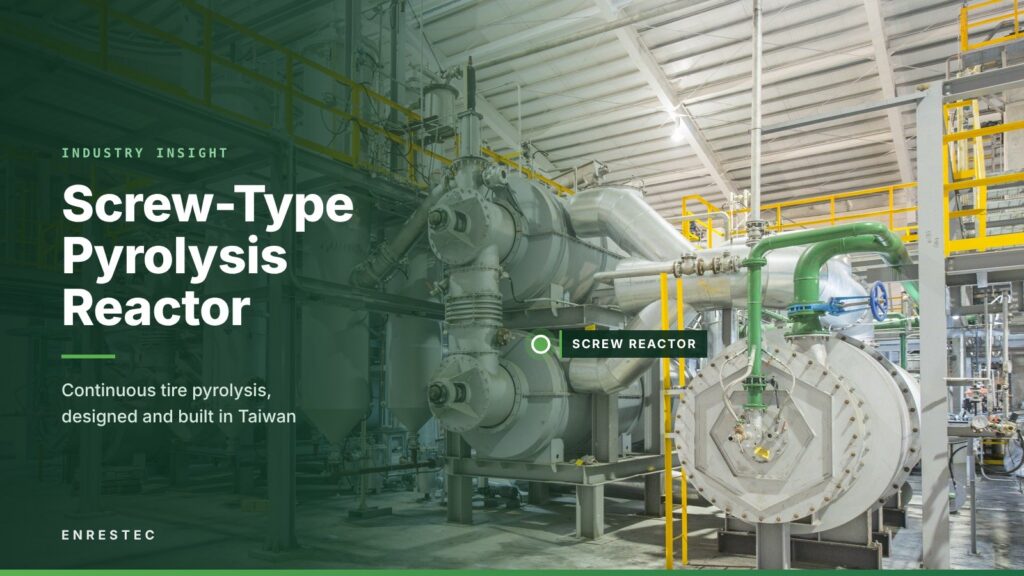
A screw reactor uses a rotating screw to push feedstock through a heated, oxygen-free chamber, with residence time set simply by screw speed. The review finds it offers efficient heat transfer, continuous operation, a compact design and easy scale-up, and — together with fluidised beds — better scalability than fixed-bed systems.
It also names the challenges: large or irregular feed can clog the reactor, and pyrolysis vapours stay longer in the reactor, which can trigger secondary reactions that affect product quality. A pilot-scale study cited in the review ran for more than 100 hours, demonstrating stability and reproducibility; yet the authors conclude that the industry still lacks long-term data from commercial-scale facilities.
Enrestec’s experience
1. Our continuous system uses a screw reactor. From reactor to carbon black refining, the system is designed by Enrestec and built in Taiwan, and is protected by a Taiwan invention patent (I916255), a Taiwan utility model and a Japanese utility model.
2. Stable operation starts with pre-treatment. To address the clogging risk the review describes, we remove steel wire and then coarse- and fine-shred tires into chips under 3 cm with less than 1% steel. Consistent feed size is the foundation for long-term continuous operation of a screw reactor.
3. Not a trial, but more than a decade of commercial operation. Our Pingnan plant opened in 2013 as the world’s first waste-tire pyrolysis plant in 24-hour commercial operation. The continuous system runs at over 90% uptime and processes 24,000 tonnes of waste rubber a year — exactly the long-term, commercial-scale experience the review says the industry lacks.
4. Energy self-sufficient, with products back in the supply chain. Combustible gas from the process is recovered to fuel the heating, with no external energy needed. Crude carbon black is refined into recovered carbon black (rCB) and the oil is treated into TPO, with ISCC PLUS certification. As the review notes, consistent quality is the key to bringing rCB back into tire manufacturing — which is why we keep investing in milling and refining.
Conclusion
Research has mapped the trade-offs of each reactor type well; the real industrial hurdles are scale-up and long-term stability. Building on our Pingnan operating experience, Enrestec supplies pyrolysis equipment and technology licensing to help customers replicate proven technology worldwide. Learn more: Equipment Sales.
Reference: Maganinho, C., Silva, C. M. C., Costa, S. M. R., Mendes, A., Rocha, J., Silva, C. M., & Portugal, I. (2025). Advances in the pyrolysis of end-of-life tires: A critical review of reactor systems, process conditions and industrial applications. Journal of Environmental Chemical Engineering, 13, 118667. DOI: 10.1016/j.jece.2025.118667 (open access). This article is Enrestec’s summary and opinion based on the review. The review does not discuss Enrestec, and Enrestec has no affiliation with its authors or the journal.